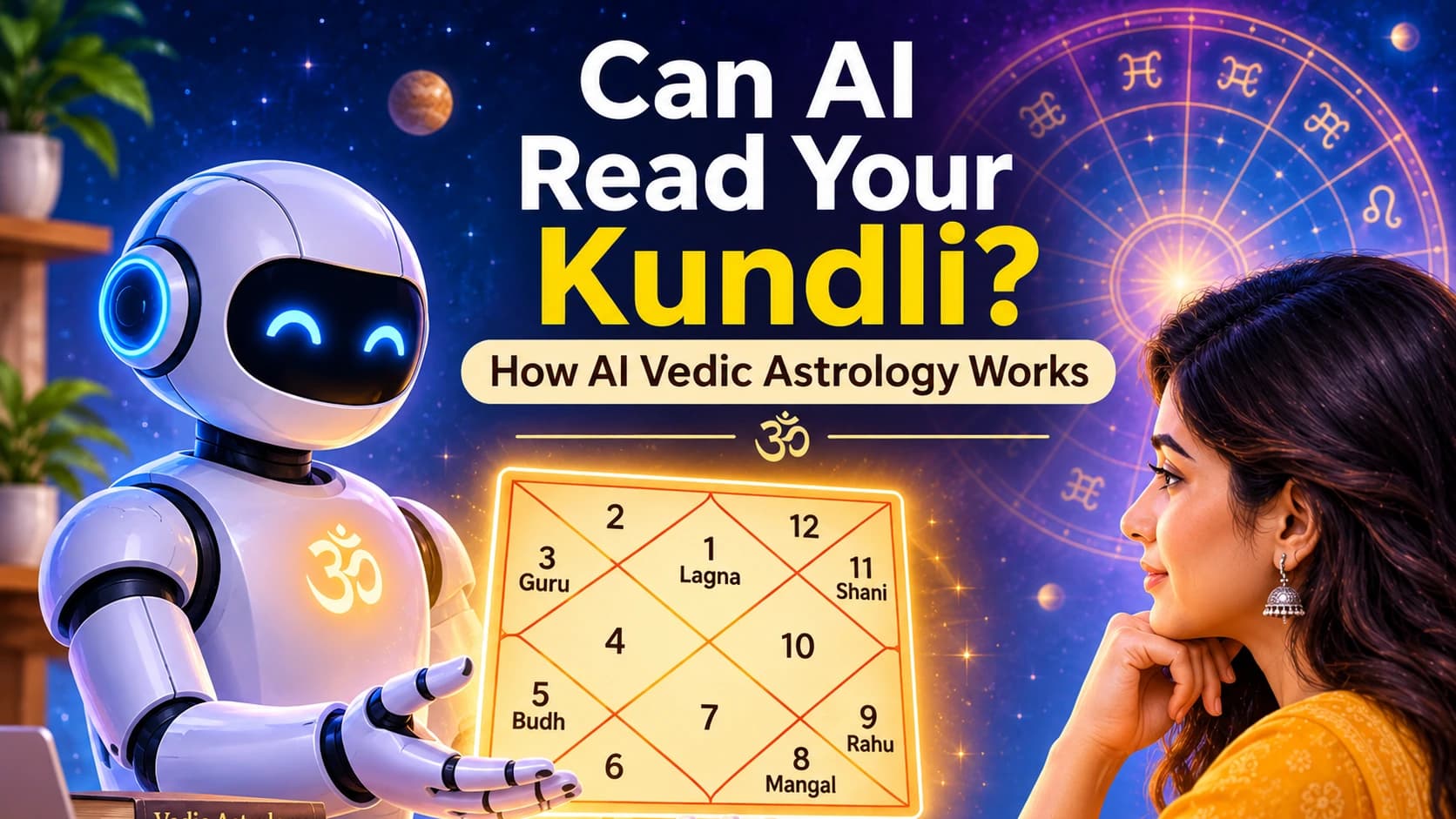
Can AI Read Your Kundli? How AI Vedic Astrology Works
Can AI Really Read Your Kundli?
You enter your date of birth, birth time and birthplace into an AI astrology app. Within moments, it starts answering questions about your career, marriage, relationships or future.
But can AI actually read your Kundli?
Or is it simply generating convincing-sounding answers based on general astrology information?
The answer depends on how the platform works behind the scenes.
A general-purpose AI model can explain zodiac signs, discuss planetary combinations and generate horoscope-style responses. But reading an individual birth chart involves much more than generating text. It requires planetary calculations, a consistent Vedic astrology framework and an interpretation based on the resulting chart.
A properly designed AI Kundli system should calculate your birth chart first and use AI to interpret the calculated information.
This distinction is important because a language model that tries to calculate an entire Kundli from memory can produce incorrect planetary positions, houses or Dasha periods while still sounding confident.
Let's understand how AI Vedic astrology actually works, what information it analyses and what you should look for before trusting an AI Kundli reading.
How Does AI Read a Kundli?
An AI astrology platform should handle the process in distinct stages.
Birth details → Astronomical calculations → Vedic birth chart → Jyotish analysis → AI interpretation
Each stage has a different responsibility.
Your birth details establish the date, time and geographical location for the chart.
An astronomical calculation engine determines planetary positions.
A Vedic astrology framework organises those positions into signs, houses, Nakshatras and other chart factors.
Traditional Jyotish calculations determine Dasha periods, divisional placements, planetary strength and other relevant information.
AI uses the prepared chart data and your question to explain the relevant astrological factors in ordinary language.
The important point is that AI interpretation should not replace astronomical or Jyotish calculations. It should work with their results.
Why Do Date, Time and Place of Birth Matter?
A personalised Kundli requires three important details:
Date of birth
Exact time of birth
Place of birth
Each detail serves a different purpose.
Date of birth helps establish the planetary positions for the day.
Birth time determines the precise moment for the chart. It is particularly important for calculating the Lagna, house structure and time-sensitive chart factors.
Birthplace provides the geographical coordinates needed for location-dependent calculations.
For example, two people born on the same date can have different Ascendants and house placements because they were born at different times or places.
An incorrect birth time can also affect divisional-chart placements, Dasha balance and planetary-strength calculations.
What happens when you do not know your exact birth time?
A system can still provide some information that remains valid throughout the birth day. However, the Lagna, houses and birth-time-dependent Dasha calculations require a sufficiently accurate time.
This is why a platform should be transparent about which chart details are available when the birth time is unknown.
You can try ChatKarmic's free Vedic Kundli calculator to generate a birth chart using your birth details. It is free to use and does not require signup.
How Are Planetary Positions Calculated?
After processing your birth details, the calculation engine determines where the relevant celestial bodies were at the time of birth.
This is where an astronomical ephemeris becomes important.
An ephemeris provides calculated positions of celestial bodies for specific dates and times. Astrology software uses these values as the foundation for planetary calculations.
ChatKarmic uses Swiss Ephemeris for planetary positions.
The purpose of using a dedicated calculation library is straightforward: planetary positions should come from a defined astronomical calculation process, not from asking a language model to estimate where a planet was on a particular date.
This is the first important difference between a chart-based AI astrology system and a generic AI chatbot.
Why Does Lahiri Ayanamsa Matter in Vedic Astrology?
Vedic astrology and Western astrology commonly use different zodiac reference systems.
Western astrology generally uses the tropical zodiac, while Vedic astrology commonly uses the sidereal zodiac.
The tropical zodiac is aligned with the seasonal equinoxes. The sidereal zodiac uses the reference of the fixed-star background. Because of the precession of the equinoxes, the two systems do not have the same zodiac starting point.
The angular difference used to relate these systems is called Ayanamsa.
Different ayanamsa conventions can produce different planetary sign positions from the same astronomical data.
ChatKarmic uses Lahiri Ayanamsa, also known as Chitrapaksha, for its Vedic chart calculations. Its published methodology specifies that the same ayanamsa is used consistently for the birth chart, current transits and Panchang calculations.
This consistency matters. A chart should not be calculated using one zodiac reference and then interpreted using another.
How Are Lagna and the Twelve Houses Determined?
The Lagna, or Ascendant, is the zodiac sign rising on the eastern horizon at the time and place of birth.
It forms the starting point for organising the twelve houses of a Vedic birth chart.
ChatKarmic uses whole-sign houses counted from the Lagna.
In this system, the entire zodiac sign containing the Ascendant becomes the first house. The next sign becomes the second house, followed by the remaining signs.
For example, if someone has Aries Lagna:
Aries is the first house.
Taurus is the second house.
Gemini is the third house.
The sequence continues through the twelve houses.
House systems matter because different calculation conventions can assign planets to different houses, even when the planetary longitudes remain unchanged.
A chart should be displayed and interpreted using the same house system. Otherwise, the interpretation may describe a different house arrangement from the one the user is viewing.
What Are Nakshatras and Why Are They Important?
Vedic astrology divides the zodiac into 27 Nakshatras, each further divided into four Padas.
A Nakshatra provides another layer of information beyond a planet's zodiac sign.
The Moon's Nakshatra is particularly important because it determines the starting point of the Vimshottari Dasha sequence.
Nakshatra and Pada information can also form part of the broader interpretation of planetary placements.
ChatKarmic calculates all 27 Nakshatras, including their Padas and ruling lords, before the AI interpretation begins.
How Does AI Use Vimshottari Dasha?
Knowing the planetary positions in a birth chart is only one part of traditional Vedic astrology. Timing is another important part of Jyotish interpretation.
Vimshottari Dasha is a traditional planetary-period system used to examine different periods of life.
It has three commonly examined levels:
Mahadasha: The major planetary period.
Antardasha: The sub-period within a Mahadasha.
Pratyantardasha: A further sub-period within an Antardasha.
The balance of the first Dasha at birth is calculated using the Moon's sidereal longitude and its position within the birth Nakshatra.
ChatKarmic calculates Vimshottari Dasha at all three levels. This information can provide context when users ask about career changes, marriage, relationships or other timing-related subjects.
For example, a career-related interpretation may consider the active Mahadasha and Antardasha alongside the relevant houses, planetary strength and D10 chart.
A Dasha period is part of a traditional astrological framework. It does not guarantee that a specific event will happen on a particular date.
You can also explore your planetary periods using ChatKarmic's free Vimshottari Dasha calculator.
What Are Divisional Charts in Vedic Astrology?
A birth chart is not always interpreted using the main D1 chart alone.
Vedic astrology uses divisional charts, also known as Vargas, to examine particular areas of life in greater detail.
ChatKarmic documents support for eight divisional charts:
D1 – Rashi: The main birth chart and foundation for traditional horoscope interpretation.
D2 – Hora: Traditionally associated with wealth and financial resources.
D3 – Drekkana: A divisional chart included in the assessment of planetary dignity through Shadbala.
D7 – Saptamsa: Traditionally examined in relation to children and progeny.
D9 – Navamsa: Used in marriage-related analysis and the assessment of underlying planetary strength.
D10 – Dashamsa: Traditionally associated with career, profession and professional achievements.
D12 – Dwadashamsa: A divisional chart included in the assessment of planetary dignity through Shadbala.
D30 – Trimshamsa: Also included in the assessment of planetary dignity through Shadbala.
An important distinction: ChatKarmic's methodology describes D1, D2, D7, D9 and D10 as charts used for relevant areas of interpretation. D1, D2, D3, D7, D9, D12 and D30 are used together in the Saptavargaja component of Shadbala. D10 is not part of that seven-chart group.
This is more meaningful than simply displaying several charts. The purpose of a divisional chart is to provide additional context for a particular interpretation, rather than to produce a separate prediction in isolation.
What Is Shadbala? How Does AI Analyse Planetary Strength?
A planet's placement is not the only factor considered in traditional Jyotish.
Its strength is also examined.
Shadbala, meaning six-fold strength, is a classical Parashari method for assessing planetary strength.
ChatKarmic calculates six components:
Sthana Bala: Positional strength.
Dig Bala: Directional strength.
Kala Bala: Temporal strength.
Cheshta Bala: Motional strength.
Naisargika Bala: Natural strength.
Drik Bala: Aspectual strength.
These components are totalled in virupas and compared with the classical minimum strength associated with each planet.
The positional component includes Saptavargaja Bala, which examines a planet's dignity across seven divisional charts: D1, D2, D3, D7, D9, D12 and D30.
This is why an exact birth time and place matter for Shadbala calculations.
ChatKarmic's methodology also states that its Shadbala calculations are checked against a published classical worked example.
For a career-related question, planetary strength can provide additional context when examining the planets and houses associated with profession and work.
What About Rahu, Ketu, Transits, Yogas and Doshas?
A detailed Vedic birth-chart analysis can involve several additional factors.
Rahu and Ketu
ChatKarmic uses the Mean Node calculation for Rahu and places Ketu exactly opposite it. Both are included in the chart interpretation.
The choice between Mean Node and True Node is a calculation convention that can differ across astrology software. A transparent platform should make its choice clear.
Planetary transits or Gochar
Transits refer to the current movement of planets and their traditional interpretation in relation to the birth chart.
ChatKarmic calculates sidereal transits using the same Lahiri Ayanamsa framework used for the natal chart.
It also uses Ashtakavarga bindus to assess transit strength. This means transits are not simply presented as a list of planets moving through zodiac signs. Their traditional strength is considered in relation to the chart.
Yogas and Doshas
The platform's published methodology includes identification of classical Yogas and checks for commonly discussed conditions such as:
Manglik or Mangal Dosha
Sade Sati
Kaal Sarp Dosha
These should not be treated as automatic verdicts about someone's life. Their traditional interpretation depends on the wider chart context and relevant combinations or cancellations.
A responsible AI Kundli reading should explain what a particular factor traditionally means and what it does not establish.
Where Does AI Actually Come In?
This is the most important distinction when evaluating an AI astrologer.
A language model is designed to understand questions, process information and generate explanations. It should not be treated as a replacement for a dedicated astronomical calculation engine.
ChatKarmic separates the process into two stages.
Stage 1: Calculate the Kundli
The astronomical and Jyotish calculation engine prepares the chart information before AI is involved.
This includes planetary longitudes, houses, Nakshatras, Padas, Dasha periods, divisional placements, Shadbala, Ashtakavarga counts, Yogas and Doshas.
Stage 2: Interpret the calculated chart
The AI receives the calculated information along with the user's actual question.
It uses the supplied chart data to explain the relevant Jyotish factors in conversational language.
According to ChatKarmic's published methodology, the AI does not independently derive planetary positions and is not permitted to recompute or override the calculated figures.
This separation is important because a language model can produce a fluent answer while getting the underlying chart information wrong.
The calculation engine handles the numerical and Jyotish calculations. AI helps make the resulting interpretation easier to understand and discuss.
An Example: How AI Can Analyse a Career Question
Suppose you ask:
"Will I get a better job opportunity this year?"
A chart-based AI system should not start by guessing where the planets were at your birth.
The relevant chart information should already be available.
Depending on the interpretation methodology, a career reading may consider:
The 10th house and its lord.
Relevant planetary placements and dignity.
The 2nd, 6th and 11th houses.
Vimshottari Mahadasha and Antardasha.
The D10 Dashamsa chart.
Shadbala and relevant planetary strength.
Current sidereal transits and Ashtakavarga.
The AI then explains how these factors are traditionally interpreted in relation to your question.
You can ask follow-up questions in ordinary language without needing to know how to calculate every chart factor yourself.
For more examples, read our guide to 15 questions you can ask an AI astrologer about your career.
How Does ChatKarmic Check Its Kundli Calculations?
Using a dedicated calculation engine is important, but a methodology should also explain how its results are checked.
According to ChatKarmic's published methodology, planetary positions are checked through an independent astronomical comparison.
The process described on the methodology page includes:
Independent planetary-position comparison
Planetary positions calculated using Swiss Ephemeris are independently recomputed using a NASA JPL planetary ephemeris. The two sets of results are compared to identify differences.
Complete chart and reference-case comparisons
Complete charts are compared with reference readings from an established Indian astrology platform.
Additional fixed reference cases cover:
Vimshottari Dasha periods.
Divisional-chart placements.
Ashtakavarga counts.
Shadbala calculations, checked against a published classical worked example.
These checks are intended to identify numerical differences and inconsistencies in the chart-calculation process.
It is important to understand their limits. These are validation processes described by ChatKarmic, not independent third-party certification of the complete product.
Checking planetary calculations does not prove that astrological predictions are scientifically accurate. Numerical consistency and predictive accuracy are two different questions.
You can read the complete technical details on How ChatKarmic Calculates Your Chart.
Can AI Predict Your Future Accurately?
AI can explain how traditional Jyotish methods interpret your birth chart, planetary periods and current transits.
But that does not mean it can guarantee future events.
There are two separate questions:
Are the chart calculations consistent?
This concerns the calculation method, birth details, planetary positions, house system and other numerical results.
Will the astrological interpretation accurately predict what happens?
This concerns the predictive claims of astrology and how its traditional factors are interpreted.
A system can check planetary positions against an astronomical reference without proving that a prediction about marriage, career, health or financial success will come true.
AI can also make mistakes while interpreting chart information. A confident answer is not automatically a correct one.
ChatKarmic presents its astrology readings for guidance, exploration and self-reflection. They should not replace medical, legal, financial or other qualified professional advice.
How to Choose an AI Kundli Reading App
Before using an AI astrology platform, look beyond its chatbot interface.
Ask these questions:
1. Does it use your complete birth details?
A personalised Kundli requires your date of birth, birth time and birthplace. A reading based only on your zodiac sign is not equivalent to a complete birth-chart analysis.
2. Does it disclose its zodiac system and Ayanamsa?
Check whether it uses the sidereal or tropical zodiac and whether it explains the ayanamsa used for Vedic calculations.
3. Does it explain its house system?
The house system affects how planetary positions are organised and interpreted.
4. Does it calculate Dasha periods?
If you are interested in timing-related questions, check whether the platform supports a defined system such as Vimshottari Dasha.
5. Does it use divisional charts and planetary strength?
Look for an explanation of how relevant Vargas, Shadbala, transits and other chart factors are used.
6. Does AI receive calculated chart data?
This is one of the most important questions. The platform should explain whether AI interprets structured birth-chart information or simply generates answers using general astrology knowledge.
7. Is the methodology transparent?
A trustworthy platform should explain its calculation conventions, validation approach, limitations and privacy practices.
A polished chatbot alone does not make an AI astrology application reliable. The calculation process and the way the AI uses its results matter.
Try Your Free Kundli on ChatKarmic
Understanding AI Vedic astrology is easier when you can explore an actual birth chart.
ChatKarmic combines a dedicated Kundli calculation system with AI-powered interpretation. It uses sidereal calculations, Lahiri Ayanamsa, whole-sign houses, Vimshottari Dasha and additional Jyotish factors before AI responds to your questions.
You can start by generating your own birth chart.
Create Your Free Vedic Kundli on ChatKarmic
The free Kundli calculator does not require signup. Enter your birth details to explore your Lagna, Rashi and planetary positions.
After exploring your chart, you can learn more about the calculation standards on the ChatKarmic methodology page and discover how AI astrologers use chart information to answer questions.
Frequently Asked Questions About AI Kundli Reading
Can AI really read my Kundli?
Yes, an AI system can help interpret a Kundli when it receives properly calculated birth-chart information. A reliable chart-based system should calculate planetary positions, houses, Nakshatras and other relevant factors before generating an interpretation.
Can ChatGPT calculate my Kundli accurately?
A general-purpose chatbot can explain Vedic astrology and discuss chart details you provide. However, it should not automatically be treated as a dedicated astronomical calculation engine. For a complete Kundli, use a system with a defined planetary calculation method and clearly stated Jyotish conventions.
Can AI read my Kundli using only my date of birth?
A complete birth chart generally requires the date, exact time and birthplace. Without an accurate birth time, the Lagna, houses and some time-dependent calculations cannot be established reliably.
What is the difference between an AI horoscope and an AI Kundli reading?
A general horoscope may provide a broad reading based on a zodiac sign. An AI Kundli reading uses individual birth details to prepare a chart containing planetary positions, Lagna, houses, Nakshatras, Dashas and other relevant factors.
Does AI use actual planetary positions?
A properly designed chart-based system can use an astronomical ephemeris or calculation library to determine planetary positions. AI can then interpret those calculated values rather than estimating them from general knowledge.
What is Lahiri Ayanamsa?
Lahiri, also known as Chitrapaksha Ayanamsa, is a widely used convention in Indian sidereal astrology. It accounts for the difference between tropical and sidereal zodiac reference systems.
What is Shadbala in Vedic astrology?
Shadbala is a classical six-fold method for assessing planetary strength. It includes positional, directional, temporal, motional, natural and aspectual strength.
Why are divisional charts important?
Divisional charts, or Vargas, provide additional context for examining particular areas of life. For example, D9 is traditionally used for marriage-related analysis, D10 for career and D7 for children.
Can AI astrology guarantee marriage, career or financial predictions?
No. AI can explain traditional astrological interpretations of relevant chart factors, but it cannot guarantee that a particular event or outcome will occur.
Final Thoughts
AI does not understand your Kundli simply because it can generate a fluent answer.
A meaningful AI Kundli reading depends on what happens before the response is generated: how birth details are processed, how planetary positions are calculated, which Jyotish conventions are followed and whether the AI receives the correct chart information.
The calculation engine prepares the chart. Traditional Jyotish provides the interpretive framework. AI helps explain the resulting information through conversation.
That is the difference between a generic AI horoscope and a chart-based AI Vedic astrology experience.
Before trusting an AI astrologer, understand how it calculates your Kundli and how it uses the resulting chart. And if you are curious about your own birth chart, start with a free Kundli and explore the information for yourself.
AI-powered astrological guidance based on your exact birth details — available 24/7
Try ChatKarmic Free →