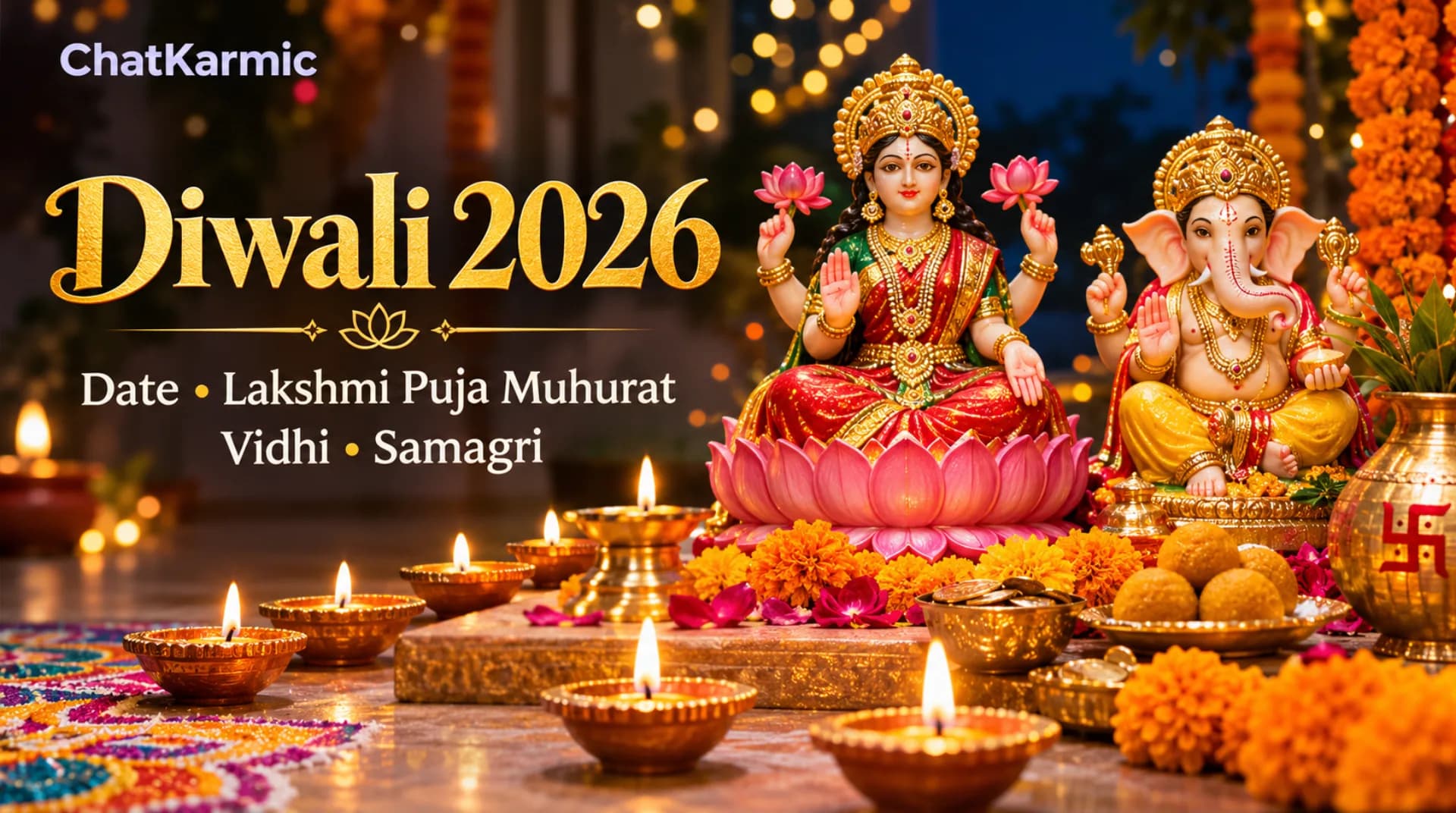
Diwali 2026: Date, Lakshmi Puja Muhurat, Vidhi & Samagri
Diwali, also known as Deepavali or Deepawali, is one of the most widely celebrated Hindu festivals. The festival symbolises the victory of light over darkness, knowledge over ignorance and good over evil. Homes are illuminated with earthen lamps, colourful rangolis decorate entrances, families exchange sweets and gifts, and prayers are offered to Goddess Lakshmi and Lord Ganesha.
In 2026, Diwali falls on Sunday, November 8. The main evening observance is Lakshmi-Ganesha Puja, performed during an auspicious period associated with Pradosh Kaal and Amavasya.
For people preparing for the festival, knowing the correct puja timing, arranging the samagri and understanding the traditional worship procedure can make the celebration more meaningful.
This guide covers Diwali 2026 date, Delhi Lakshmi Puja muhurat, Amavasya tithi, selected city-wise timings, puja vidhi, samagri, mantras and the significance of Deepavali.
Diwali 2026: Date and Important Timings
Diwali Date: Sunday, November 8, 2026
Festival: Deepavali / Deepawali
Main Puja: Lakshmi-Ganesha Puja
New Delhi Lakshmi Puja Muhurat: 5:54 PM to 7:50 PM IST
Pradosh Kaal: 5:31 PM to 8:09 PM IST
Vrishabha Kaal: 5:54 PM to 7:50 PM IST
Amavasya Tithi Begins: 11:27 AM on November 8, 2026
Amavasya Tithi Ends: 12:31 PM on November 9, 2026
Important: These timings are for New Delhi. Lakshmi Puja muhurat depends on local sunset, tithi and astrological calculations, so it varies between cities. Check your local Panchang before performing the puja.
Diwali 2026: City-Wise Lakshmi Puja Muhurat
According to the published 2026 city-wise timings, the evening Lakshmi Puja windows include:
New Delhi: 5:54 PM to 7:50 PM
Pune: 6:24 PM to 8:24 PM
Chennai: 6:07 PM to 8:09 PM
Jaipur: 6:03 PM to 7:59 PM
These are city-specific local timings. Other locations may have different muhurat windows.
Do not automatically follow the Delhi timing if you are celebrating in another city.
Why Is Lakshmi Puja Performed During Pradosh Kaal?
Diwali Lakshmi Puja is traditionally performed during the evening, particularly when Pradosh Kaal overlaps with Amavasya Tithi.
Pradosh Kaal is the period after sunset and is considered an important time for worship in several Hindu traditions.
For Diwali, the Vrishabha Lagna, which is considered a fixed sign or Sthir Lagna in Vedic astrology, often overlaps with Pradosh Kaal. This is why many Panchang calculations identify this period as an appropriate time for Lakshmi Puja.
For New Delhi in 2026, the published Lakshmi Puja window falls between 5:54 PM and 7:50 PM.
Some traditions and specialised practitioners also observe Mahanishita Kaal for particular forms of worship. However, household Lakshmi Puja is commonly performed during the evening Pradosh period.
Diwali 2026: Important Festival Dates
Diwali is part of a larger festive period that includes several religious observances. The exact sequence and names of the celebrations can differ by region.
For the New Delhi calendar, the associated observances are:
November 5 – Govatsa Dwadashi: Observed in some regional traditions.
November 6 – Dhanteras: Associated with Goddess Lakshmi, Lord Kubera and Dhanvantari.
November 7 – Kali Chaudas: Observed with regional rituals and Hanuman worship in some traditions.
November 8 – Narak Chaturdashi and Diwali: Lakshmi Puja and the main Deepavali celebration.
November 9 – Amavasya observances: Diwali Snan and Devpuja are listed in the Delhi calendar.
November 10 – Govardhan Puja: Also known as Annakut.
November 11 – Bhai Dooj: Celebrating the bond between brothers and sisters.
Some observances overlap in 2026, so the festival calendar does not fall into five consecutive calendar dates in the same way every year. Follow your regional Panchang for the customs observed in your community.
What Is the Significance of Diwali?
Diwali carries several cultural and religious meanings across India.
1. The Return of Lord Rama to Ayodhya
In many North Indian traditions, Diwali commemorates the return of Lord Rama to Ayodhya after fourteen years of exile and his victory over Ravana.
According to the traditional account, people illuminated the city with rows of lamps to celebrate the return of Rama, Sita and Lakshmana.
This story is one of the best-known explanations for the tradition of lighting diyas during Diwali.
2. Worship of Goddess Lakshmi
Goddess Lakshmi is worshipped during Diwali as the deity associated with prosperity, abundance and well-being.
Families pray for happiness, peace, financial stability and prosperity in the coming year.
The evening Lakshmi Puja is one of the central rituals of the festival.
3. Worship of Lord Ganesha
Lord Ganesha is worshipped alongside Goddess Lakshmi in many households.
He is traditionally regarded as the remover of obstacles and the deity associated with auspicious beginnings, wisdom and success.
Many families begin their Lakshmi Puja by worshipping Lord Ganesha.
4. The Symbolism of Light
Lighting diyas has an important symbolic meaning.
The lamps represent hope, awareness and the victory of light over darkness. They also create an atmosphere of happiness, celebration and togetherness.
5. Regional and Religious Traditions
Diwali is celebrated in different ways across India and by several communities.
Some communities associate the festival with other religious and historical events, while the rituals, stories and deities worshipped may differ.
Its meaning is therefore broader than one single story or regional tradition.
Diwali Lakshmi Puja Samagri: Complete Checklist
Preparing the puja samagri in advance makes it easier to perform the evening worship.
Commonly used items include:
Puja Setup
Wooden chowki or raised platform
Clean red or yellow cloth
Images or idols of Goddess Lakshmi and Lord Ganesha
Kalash filled with water
Coconut and mango leaves
Puja thali
Puja Materials
Roli or kumkum
Haldi
Chandan or sandalwood paste
Akshat, meaning unbroken rice grains
Flowers and garlands
Betel leaves and supari
Coins or traditional offerings
Fruits and sweets
Lighting and Fragrance
Earthen diyas
Ghee or oil
Cotton wicks
Incense sticks or dhoop
Camphor
Matchbox or lighter
Bell
Naivedya and Offerings
Panchamrit
Traditional sweets
Kheel and batashe, where customary
Fruits
Dry fruits
Other offerings according to family tradition
Additional Items
Account books or Bahi-Khata for traditional business puja
Pens and other stationery
Silver or gold coins, if used in the family's tradition
Rangoli colours or flowers for decoration
The exact samagri differs between families and regional customs. Not every household needs every item on this list.
Diwali Lakshmi-Ganesha Puja Vidhi: Step-by-Step
The following is a simple outline of a commonly followed household Lakshmi-Ganesha Puja. More elaborate Shodashopachara rituals may be performed according to family traditions or with the guidance of a priest.
1. Clean and Decorate the Home
Before the puja, clean the house and arrange the worship area.
Decorate the entrance with rangoli, flowers and diyas. Many families also use torans and marigold garlands.
Traditionally, a clean and welcoming home is prepared for the arrival of Goddess Lakshmi.
2. Prepare the Puja Chowki
Place a clean cloth over a wooden chowki or raised platform.
Arrange the images or idols of Goddess Lakshmi and Lord Ganesha according to your family's established puja tradition.
Keep the kalash, flowers, diya, roli, akshat and other offerings ready.
3. Begin with Ganesh Puja
In many household traditions, Lord Ganesha is worshipped before beginning the main Lakshmi Puja.
Offer flowers, roli, akshat, incense and a sweet.
A commonly recited mantra is:
ॐ गं गणपतये नमः।
4. Perform Kalash Sthapana
Place the prepared kalash near the puja arrangement.
Depending on the family tradition, it may contain water, a coin and other offerings, with mango leaves and a coconut placed on top.
Offer prayers for peace, auspiciousness and prosperity.
5. Worship Goddess Lakshmi
Offer flowers, kumkum, haldi, akshat and traditional sweets to Goddess Lakshmi.
Light the diya and incense and pray for happiness, peace, prosperity and well-being.
A commonly recited Lakshmi mantra is:
ॐ ह्रीं श्रीं लक्ष्म्यै नमः।
Om Hreem Shreem Lakshmyai Namah.
Chant according to your devotion and family tradition.
6. Offer Naivedya and Prasad
Offer fruits, sweets, dry fruits and other traditional food items.
Some families also offer kheel, batashe, makhana or homemade sweets.
7. Perform Lakshmi Aarti
After completing the offerings, perform the aarti of Goddess Lakshmi and Lord Ganesha.
Family members may gather to participate in the prayers.
8. Worship Account Books and Business Assets
Many business families traditionally worship their Bahi-Khata, account books, cash boxes and tools of work during Diwali.
Some communities also perform Chopda Puja as part of the festival.
These customs are particularly associated with business communities and may differ by region.
9. Light Diyas Around the Home
After the puja, light diyas at the entrance, windows, balconies and other suitable places.
Some families also light lamps near the Tulsi plant and other sacred spaces.
Place lamps safely, away from curtains, paper, furniture and other flammable materials. Never leave burning lamps unattended.
Lakshmi Mantra for Diwali 2026
A simple Lakshmi mantra that can be recited during Diwali Puja is:
ॐ ह्रीं श्रीं लक्ष्म्यै नमः।
Om Hreem Shreem Lakshmyai Namah.
The mantra is traditionally recited with devotion while praying to Goddess Lakshmi.
You can chant it according to your capacity and the practice followed in your family.
Why Are Lakshmi and Ganesha Worshipped Together?
Goddess Lakshmi and Lord Ganesha are worshipped together during Diwali in many Hindu households.
Goddess Lakshmi represents prosperity, abundance and well-being. Lord Ganesha is associated with wisdom, auspicious beginnings and the removal of obstacles.
Their joint worship symbolises the traditional belief that prosperity should be accompanied by wisdom and good judgement.
Financial wealth alone is not considered sufficient for a balanced and meaningful life. Wisdom, responsibility and the ability to use resources thoughtfully are equally important.
Why Do People Light Diyas on Diwali?
Lighting diyas is one of the most recognisable Diwali traditions.
In the traditional story of Lord Rama's return to Ayodhya, rows of lamps were lit to welcome him after his victory over Ravana.
Beyond this association, diyas are widely understood as symbols of light, hope, positivity and the removal of darkness.
Families decorate their homes and surroundings with lamps to create an atmosphere of celebration and welcome.
Diwali 2026: Common Questions
When is Diwali in 2026?
Diwali falls on Sunday, November 8, 2026. Lakshmi-Ganesha Puja is traditionally performed during the evening.
What is the Lakshmi Puja muhurat in Delhi for Diwali 2026?
The published New Delhi Lakshmi Puja muhurat is 5:54 PM to 7:50 PM IST on November 8, 2026.
What is the Pradosh Kaal on Diwali 2026 in Delhi?
Pradosh Kaal in New Delhi is listed as 5:31 PM to 8:09 PM IST.
When does Amavasya Tithi begin and end on Diwali 2026?
For New Delhi, Amavasya begins at 11:27 AM on November 8 and ends at 12:31 PM on November 9, 2026.
What is the best time to perform Lakshmi Puja?
Lakshmi Puja is traditionally performed during Pradosh Kaal while Amavasya Tithi prevails. For Delhi in 2026, the published muhurat is 5:54 PM to 7:50 PM. Check your local Panchang for other cities.
Which deities are worshipped on Diwali?
Goddess Lakshmi and Lord Ganesha are central to the household Diwali Puja. Some families also worship Goddess Saraswati, Lord Kubera and other deities according to their traditions.
What items are needed for Diwali Lakshmi Puja?
Common items include Lakshmi and Ganesha idols or images, a chowki, cloth, kalash, coconut, mango leaves, diya, cotton wicks, ghee or oil, roli, kumkum, haldi, akshat, flowers, fruits and sweets.
Why is Goddess Lakshmi worshipped on Diwali?
Goddess Lakshmi is traditionally worshipped for prosperity, abundance, happiness and well-being. The evening Amavasya Lakshmi Puja is one of the most important Diwali rituals.
Is Diwali celebrated only in North India?
No. Diwali is celebrated across India, but the customs, religious stories and associated observances vary between regions and communities.
Is the Diwali puja timing the same in every city?
No. Local sunset, Amavasya calculations and the relevant Lagna affect the puja muhurat. Always check timings for your own city.
Conclusion
Diwali is a festival of light, devotion, hope and togetherness. From lighting diyas and decorating homes to worshipping Goddess Lakshmi and Lord Ganesha, the festival brings families together through long-standing religious and cultural traditions.
Diwali 2026 falls on Sunday, November 8. For New Delhi, the published Lakshmi Puja muhurat is 5:54 PM to 7:50 PM, with Pradosh Kaal from 5:31 PM to 8:09 PM.
Prepare your puja samagri in advance, check the local Panchang and follow your family's traditional worship practices.
May this Diwali bring peace, wisdom, happiness and prosperity to every home.
Wishing you and your family a Happy Diwali 2026!
AI-powered astrological guidance based on your exact birth details — available 24/7
Try ChatKarmic Free →